
On real roads
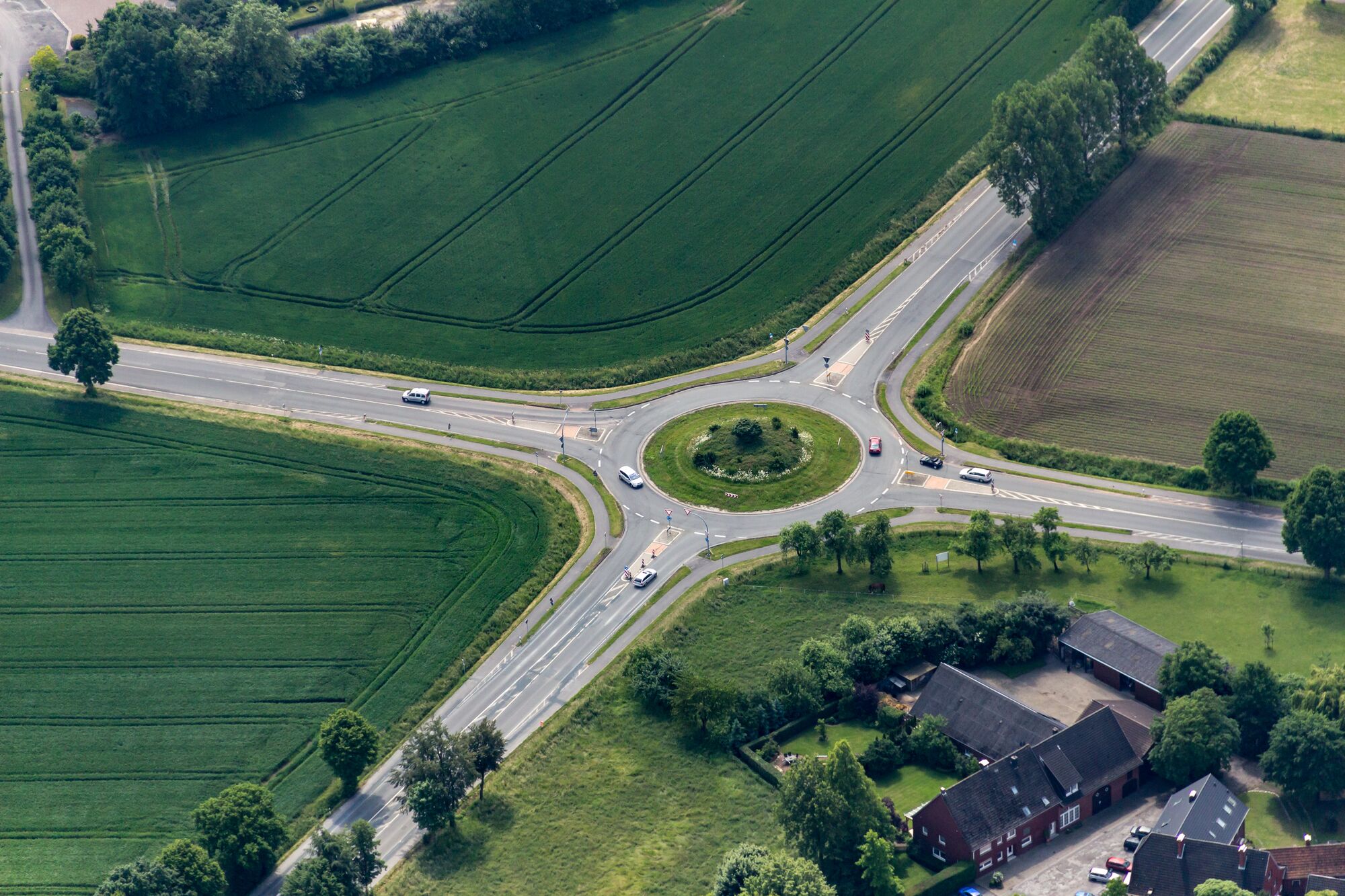
A modern roundabout is a junction where traffic goes one way round a central island and has priority over the traffic coming in.1 Its arms have splitter islands, which keep entering traffic apart from leaving traffic, and deflect and slow it.1,2,3 The curves keep speeds on the ring typically under 50 km/h (30 mph), and as all traffic goes round the same way, there are no left-turn or head-on conflicts.2,3
Circles came first: one-way traffic began round Columbus Circle in New York in 1904, and round the Place de l'Etoile in Paris in 1907.4 Entering traffic often had priority, and as traffic grew, circles locked up; in America, with their crashes and congestion, they fell out of favour from the 1950s.2,4
The modern roundabout was developed in the United Kingdom.2 Tests by the Road Research Laboratory found that giving priority to the traffic on the roundabout raised capacity by 10 percent over no control, police control or signals; injury accidents fell by 40 percent.4 The rule became mandatory in November 1966, and roundabouts were made smaller: the driver's task became to take a gap in the traffic on the ring, not to weave.2,4 Roundabouts reached Australia and some communities in France in the 1970s, and France had about 15,000 by mid-1997.4
The first two in the United States were built in Summerlin, Nevada, in March 1990.4 Studies of American junctions converted from traffic signals or stop signs, mostly of single-lane roundabouts, found 72 to 80 percent fewer injury crashes. At two-lane roundabouts crashes fell less, or even rose, though their safety improves over time as drivers get used to them.5
- Arms
- 3 or more1
- Size (Washington State)
- 24 to 46 m (80 to 150 ft) across for a single lane, as a first design range3
- Vehicle conflict points
- 8 at a four-arm, single-lane roundabout, against 32 at a four-leg junction of two-lane roads2
- Daily traffic
- up to about 20,000 vehicles on four arms and one lane before a detailed capacity check2
- Injury crashes
- 72 to 80 % fewer at US junctions converted from signals or stop signs5
- Suits
- relatively balanced traffic and frequent left turns5
- May not suit
- a very busy main road meeting a quiet side road5
Where to see one
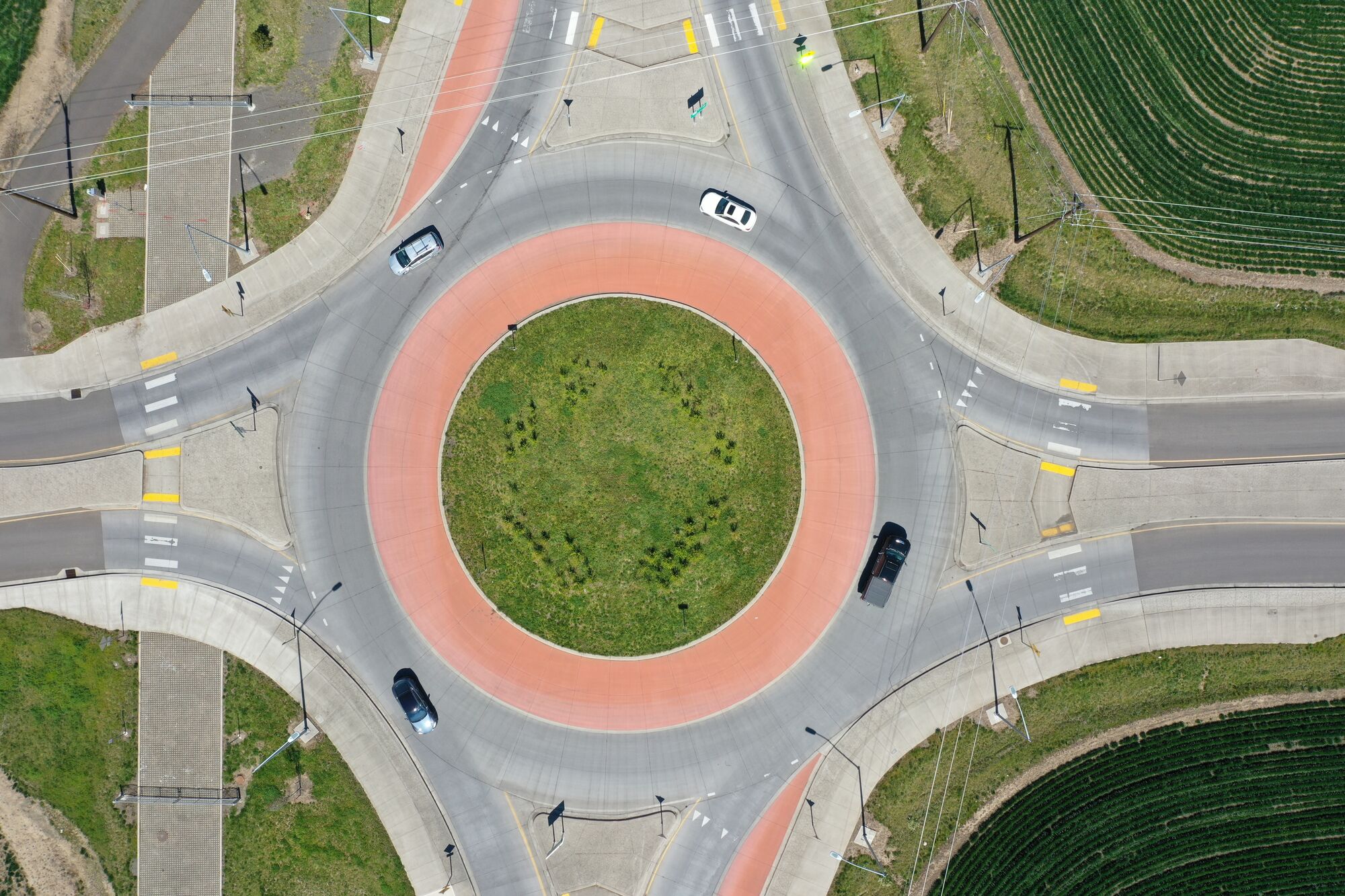
Aerial view of the roundabout on OR 47 in Forest Grove, Oregon, April 2020. Oregon Department of Transportation, CC BY 2.0, source, cropped, shown in greyscale Roundabout on OR 47, Forest Grove, Oregon, US. Map
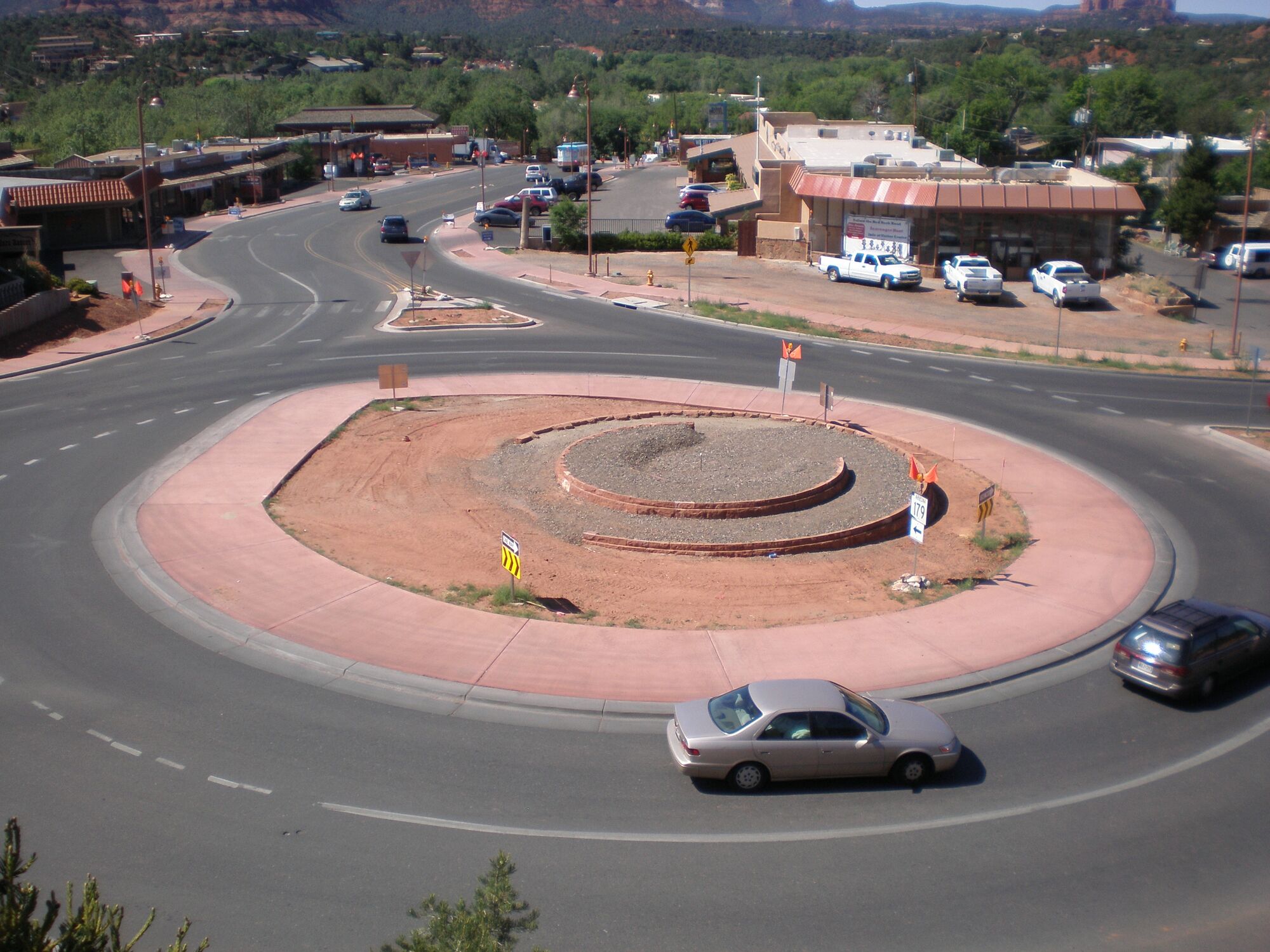
Roundabout construction nearly completed on Arizona State Route 179, in a project supported by FHWA's Highways for LIFE, May 2009. Federal Highway Administration (photo courtesy of Applied Research Associates), CC BY 2.0, source, cropped, shown in greyscale SR 179 at SR 89A, Sedona, Arizona, US. Map
The Roadform adaptation
In Roadform
A one-way ring with 3 to 6 radial arms, each with a splitter island.
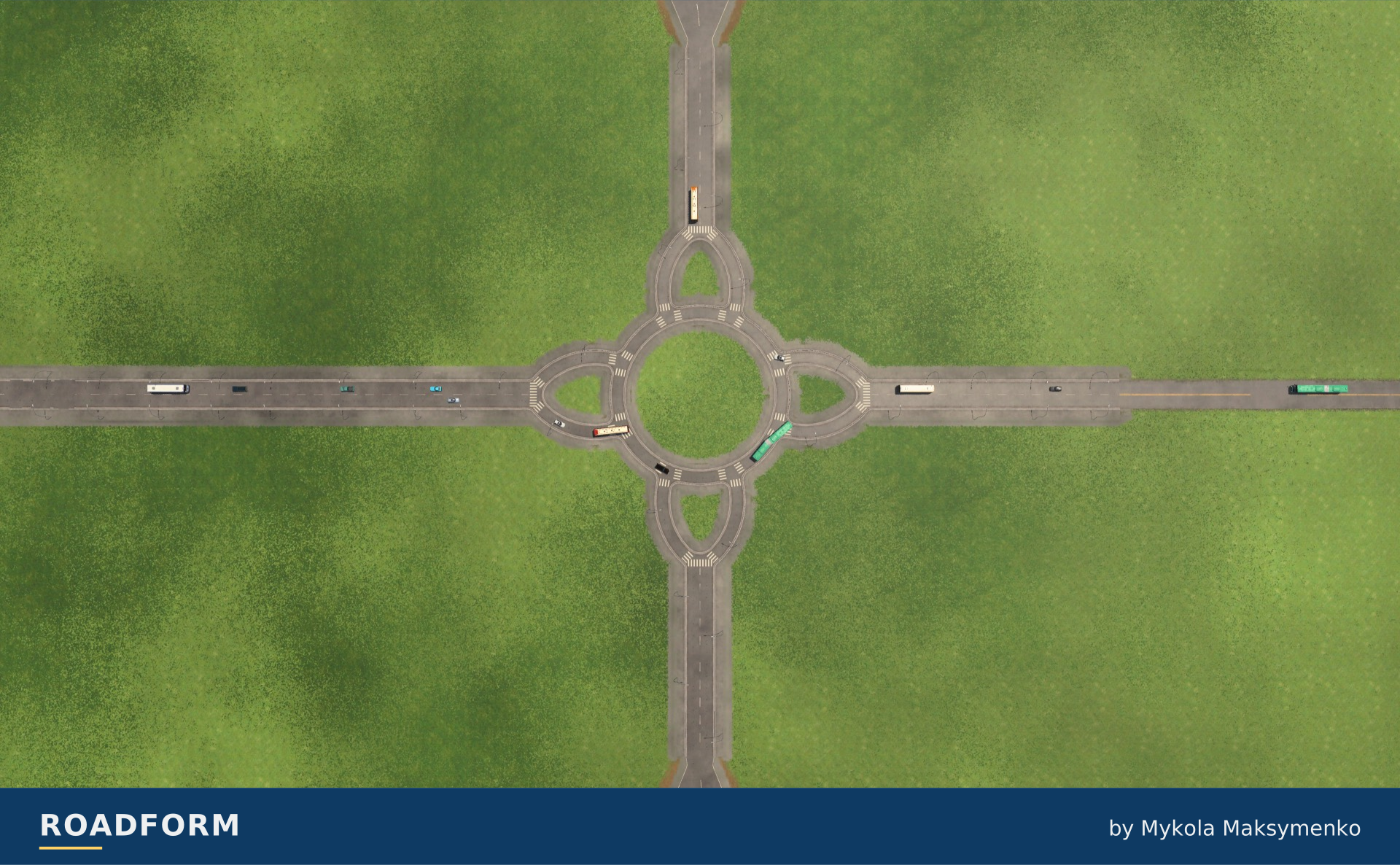
Connections around the junction
Choose the number of connecting arms. The plans hold the other options at their defaults.
TF3 · M · Bridge: None · Traffic side: Right.
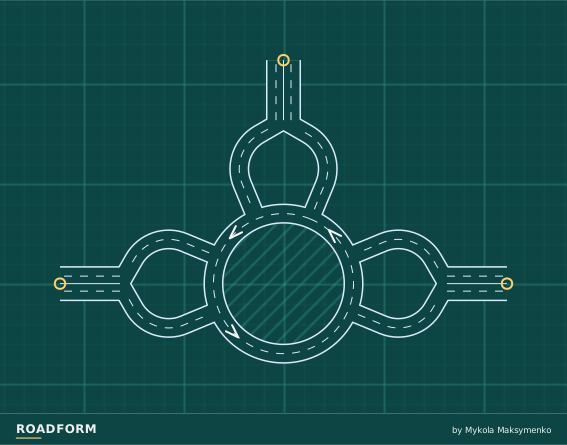
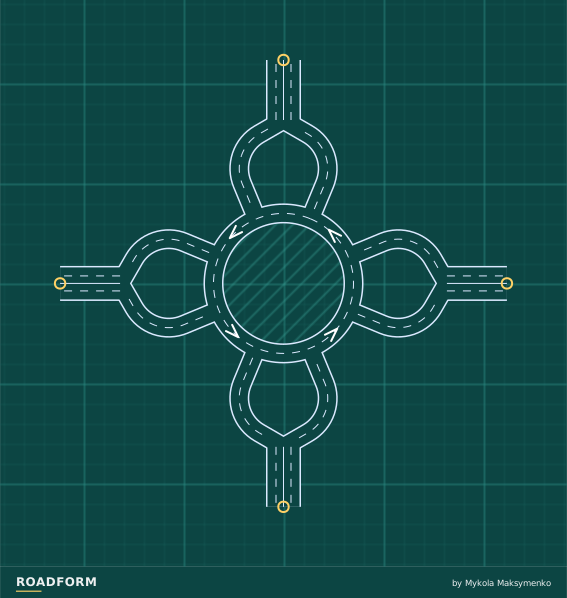
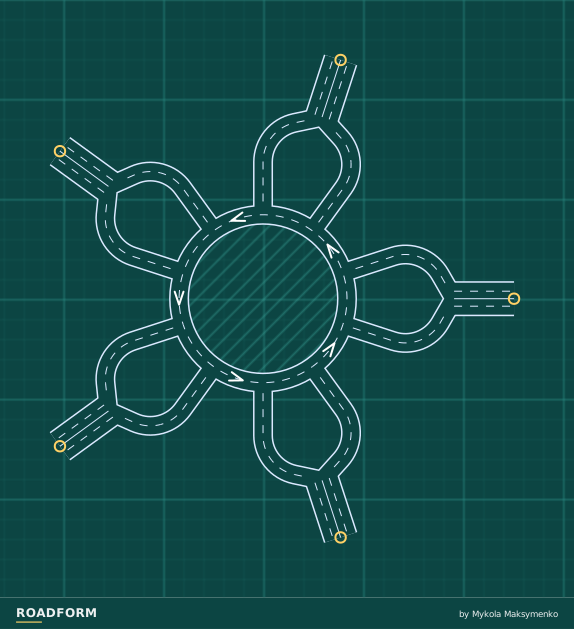
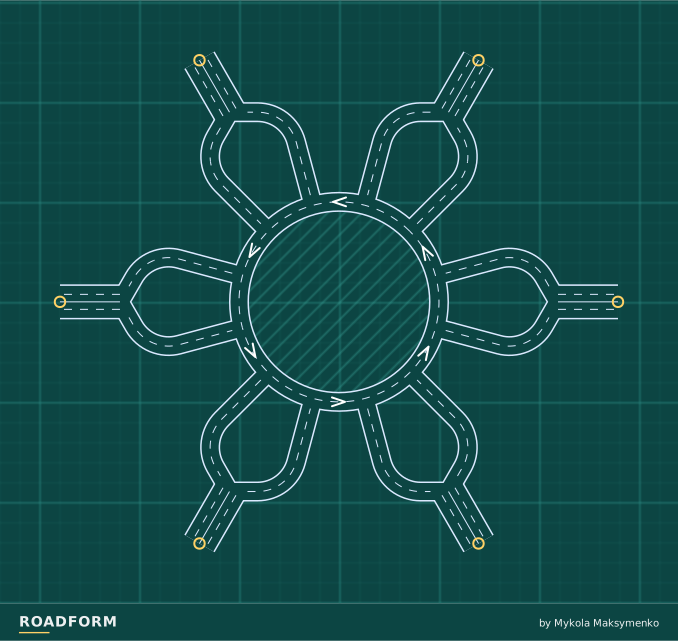
Scale and capacity
Size changes the road widths and the space the layout needs. The guide below uses the default arrangement. The layout reserves room for wider roads.
| Layout | Width × depth | Highest road | Lanes per direction |
|---|---|---|---|
| S | 179 × 179 m | 0 m | Ring: 1 Arms: 1 Turns: 1 |
| M | 223 × 223 m | 0 m | Ring: 2 Arms: 2 Turns: 2 |
| L | 246 × 246 m | 0 m | Ring: 3 Arms: 3 Turns: 3 |
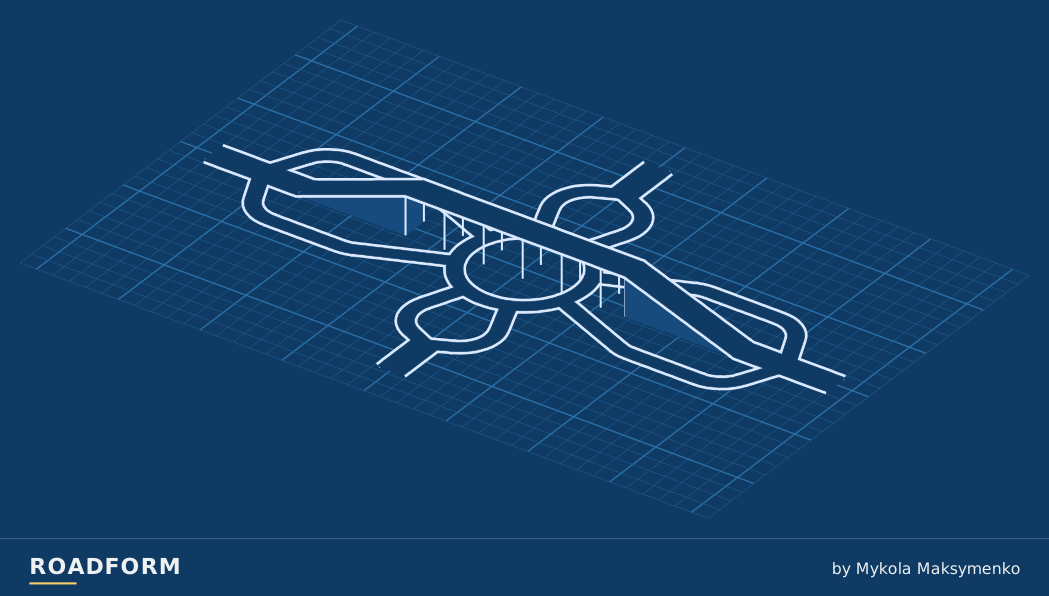
At grade or above
Keep the junction at ground level, or carry the main road across it on a bridge.
TF3 · M · Arms: 4 · Traffic side: Right. Heights ×3.

Sources and credits
- Design Manual for Roads and Bridges, CD 116 Geometric design of roundabouts, version 2.1.0, National Highways, 2023. www.standardsforhighways.co.uk
- Roundabouts: An Informational Guide (FHWA-RD-00-067), Federal Highway Administration, 2000. www.fhwa.dot.gov
- Design Manual M 22-01.23, Chapter 1320 Roundabouts, Washington State Department of Transportation, 2024. wsdot.wa.gov
- Modern Roundabout Practice in the United States (NCHRP Synthesis 264), G. Jacquemart, Transportation Research Board, 1998. onlinepubs.trb.org
- Roundabouts, Insurance Institute for Highway Safety, 2026. www.iihs.org
Real-world photo credits accompany each image. Roadform figures and measurements use Transport Fever 3.