On real roads
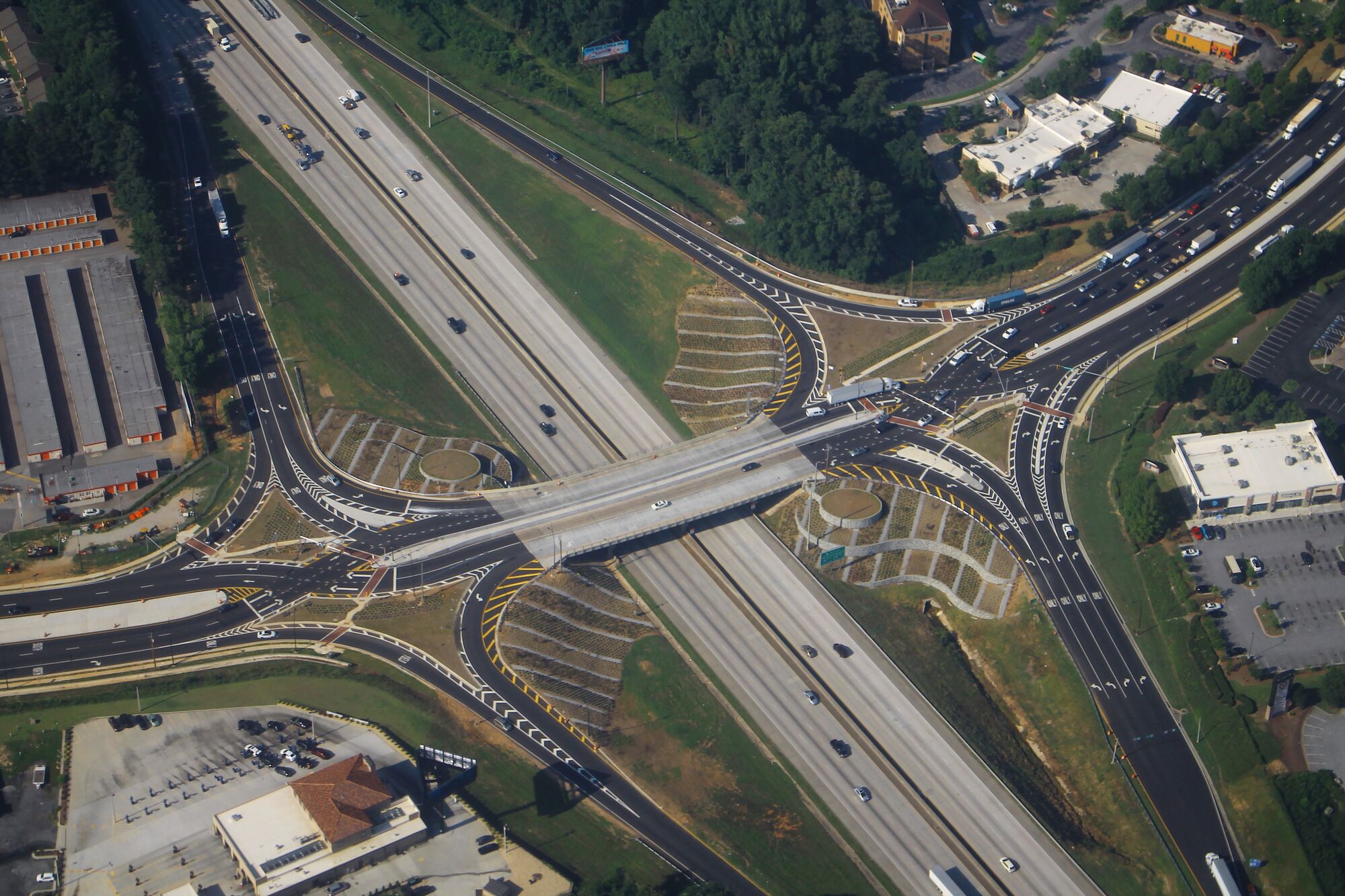
A diverging diamond interchange (DDI), or double crossover diamond, has the four ramps of an ordinary diamond.1,2 What differs is the cross road: on either side of the interchange its two directions cross over at a signal, and between the crossovers traffic keeps to the left.1,2 So a driver turning left onto or off a ramp crosses no oncoming traffic.1
The design was first developed in France.3 In 2010 the Federal Highway Administration knew of three there, on the A13 at Versailles, the A4 at Le Perreux-sur-Marne and the A1 at Seclin, and all three had existed for more than two decades.2 The first in the United States opened to traffic in June 2009 in Springfield, Missouri, where Route 13 crosses Interstate 44.1,4
By August 2014, FHWA's guide listed 36 built in the United States. Most of those it evaluated had been rebuilt from ordinary diamonds, and a diverging diamond generally fits the existing bridge and right-of-way.1 Leisch and Morrall wrote in 2014 that it was becoming increasingly popular, both to rebuild the compressed diamonds of the 1950s and 1960s and for new interchanges where a freeway meets an arterial street in a suburban area. To them it was the only entirely new interchange form of the previous thirty years.3
It can suit heavy left turns onto the highway and off it, moderate through traffic on the cross road, or a narrow bridge deck.2 Its signals run in two phases, where a diamond's usually run in three.1,2 Through traffic on the cross road is inconvenienced most: it crosses to the left and back and cannot flow freely, so where it is heavy, other forms should be considered. Traffic leaving the highway cannot go straight back onto it, and signals close by on the cross road can make the interchange harder to run.4 Pedestrians cross one direction of traffic at a time, but may have to cross turns onto the ramps that have no signal.1
- Levels
- 2
- Crossovers
- 2, each with a signal2
- Vehicle conflict points
- 14: 2 crossing, 6 merging, 6 diverging; a diamond has 261
- Signal phases
- 2, where a diamond usually has 32
- Left-turn capacity
- about twice a diamond's, in simulations1
- Speed through the crossovers
- mostly 24 to 26 mph (39 to 42 km/h), measured at seven DDIs, whatever the speed limit1
- May suit
- heavy left turns onto the highway and off it2
- Limit
- heavy through traffic on the cross road4
Where to see one
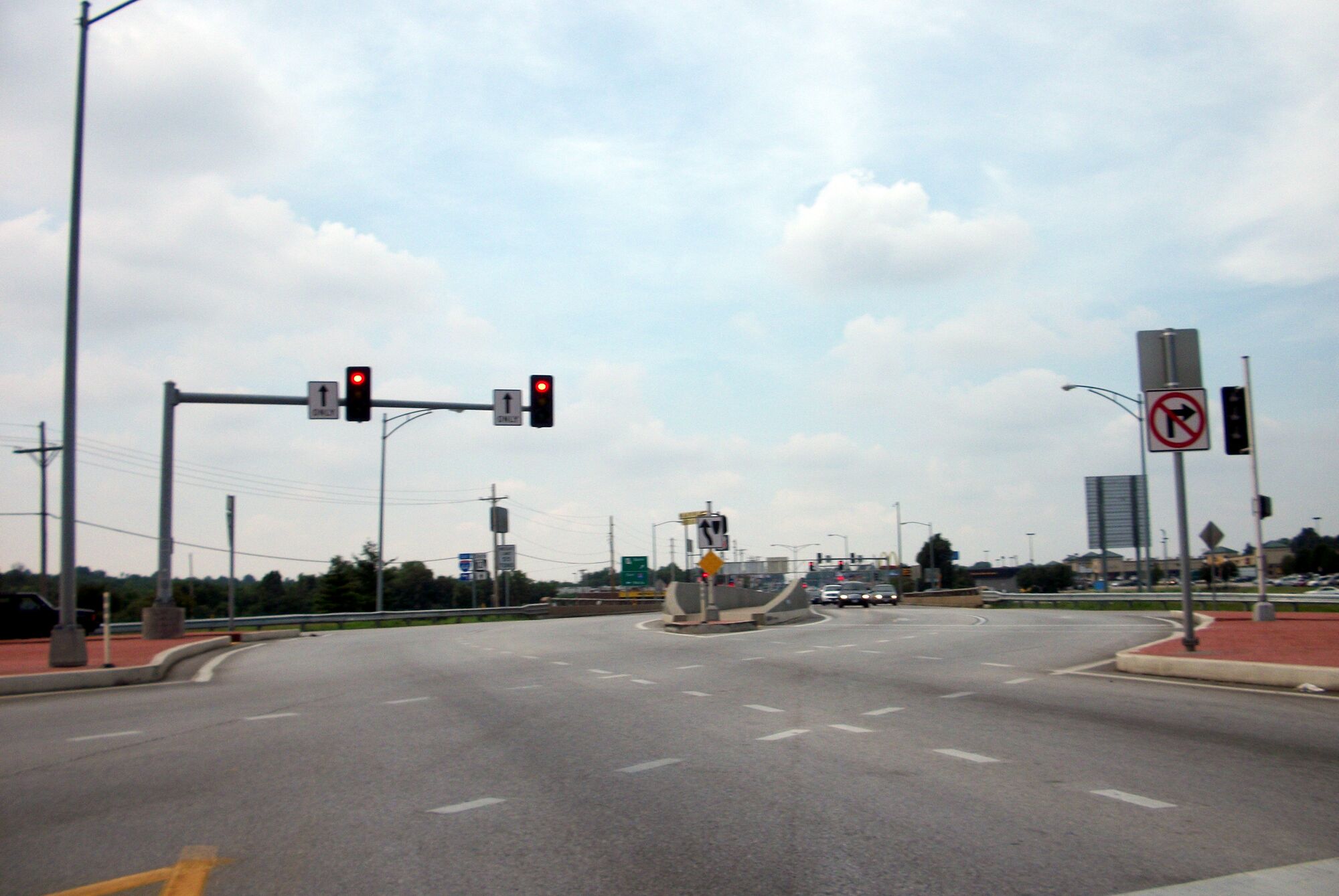
The I-44 and Route 13 diverging diamond interchange in Springfield, Missouri, 2011. Brandonrush, CC BY-SA 3.0, source, cropped, shown in greyscale I-44 at MO 13, Springfield, Missouri, US, opened 2009. Map
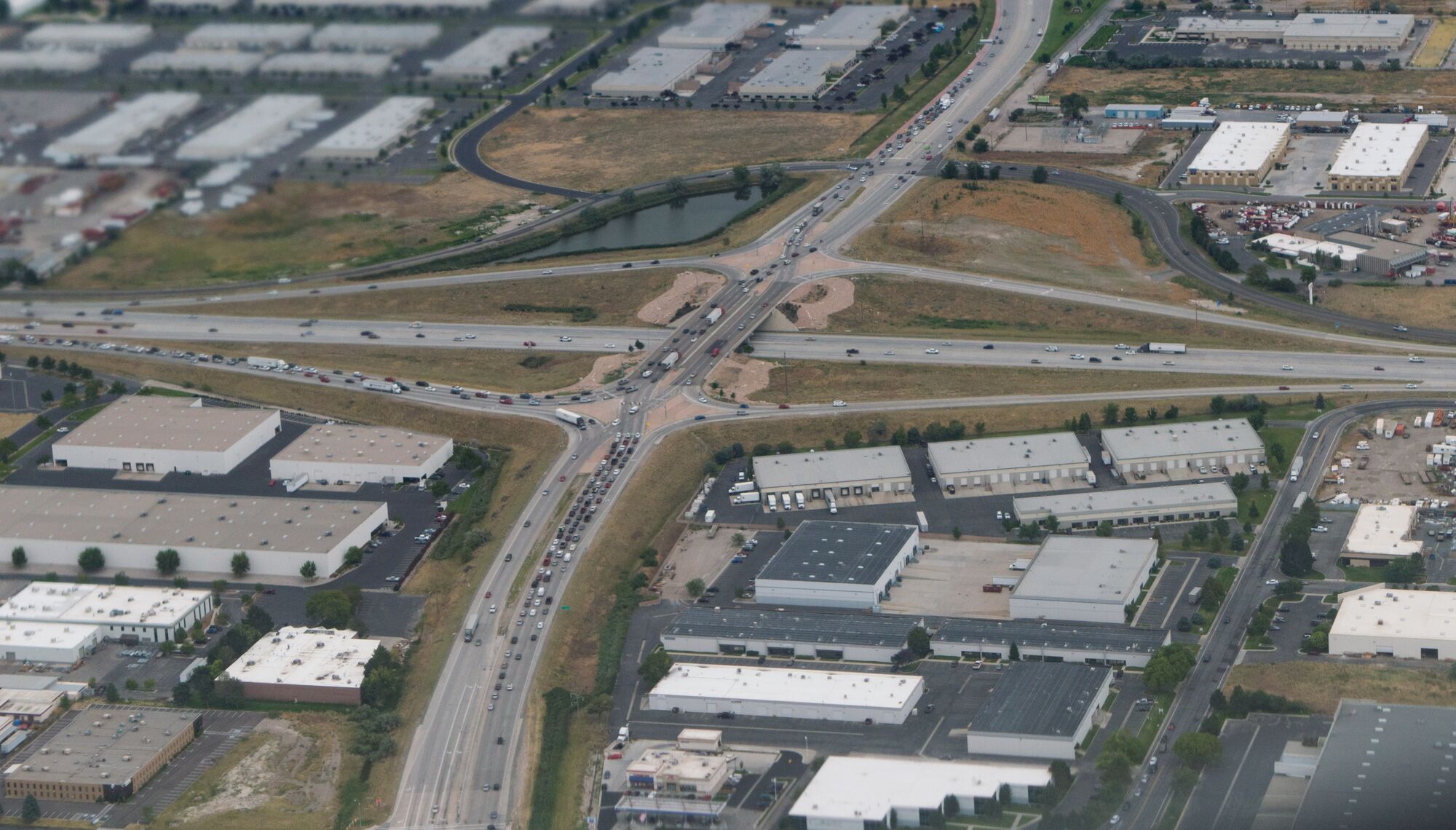
An exit of Utah State Route 201 and Utah State Route 154, seen from an aircraft, 2015. Supercarwaar, CC BY-SA 4.0, source, cropped, shown in greyscale SR-201 at Bangerter Highway, West Valley City, Utah, US. Map
The Roadform adaptation
In Roadform
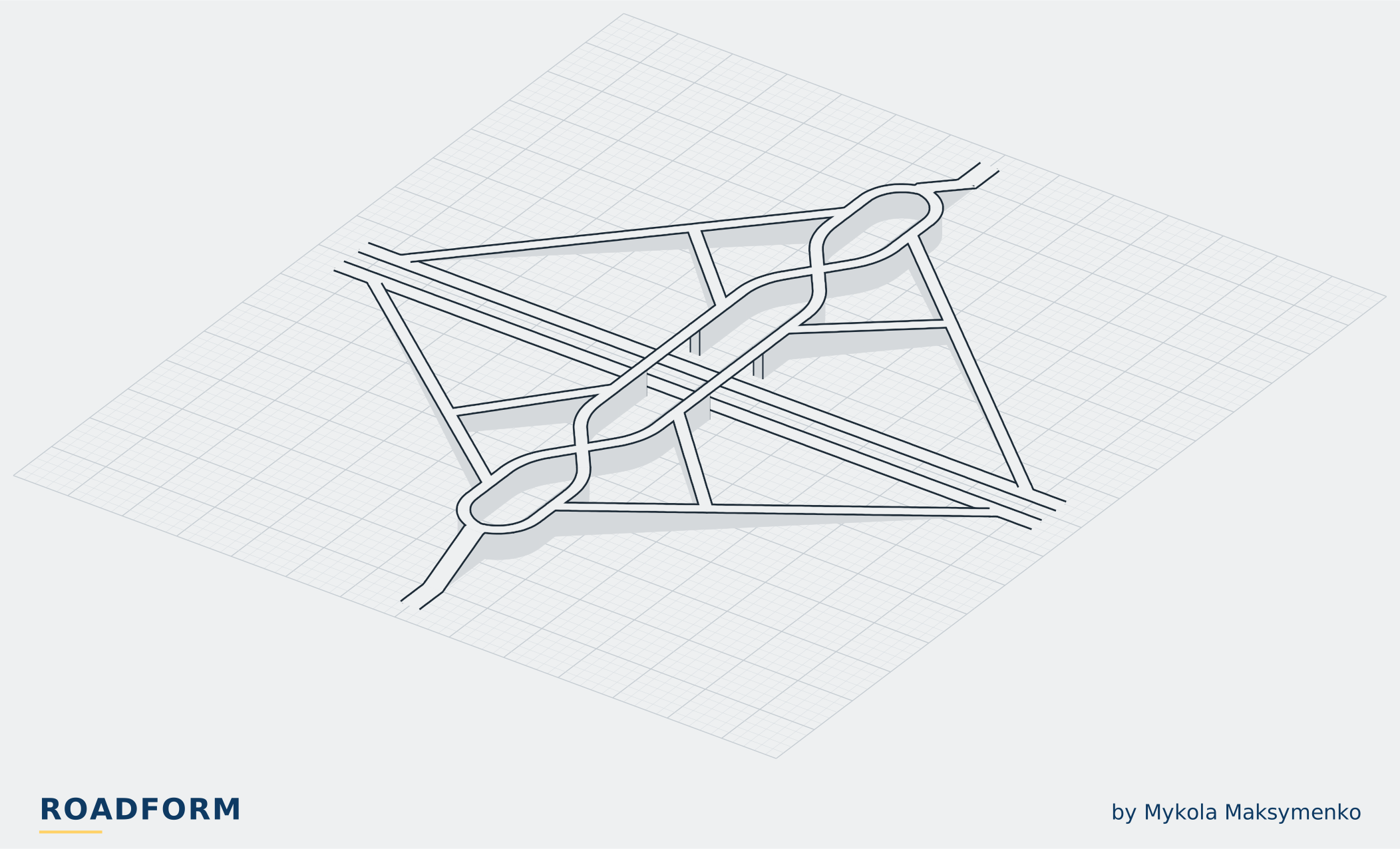
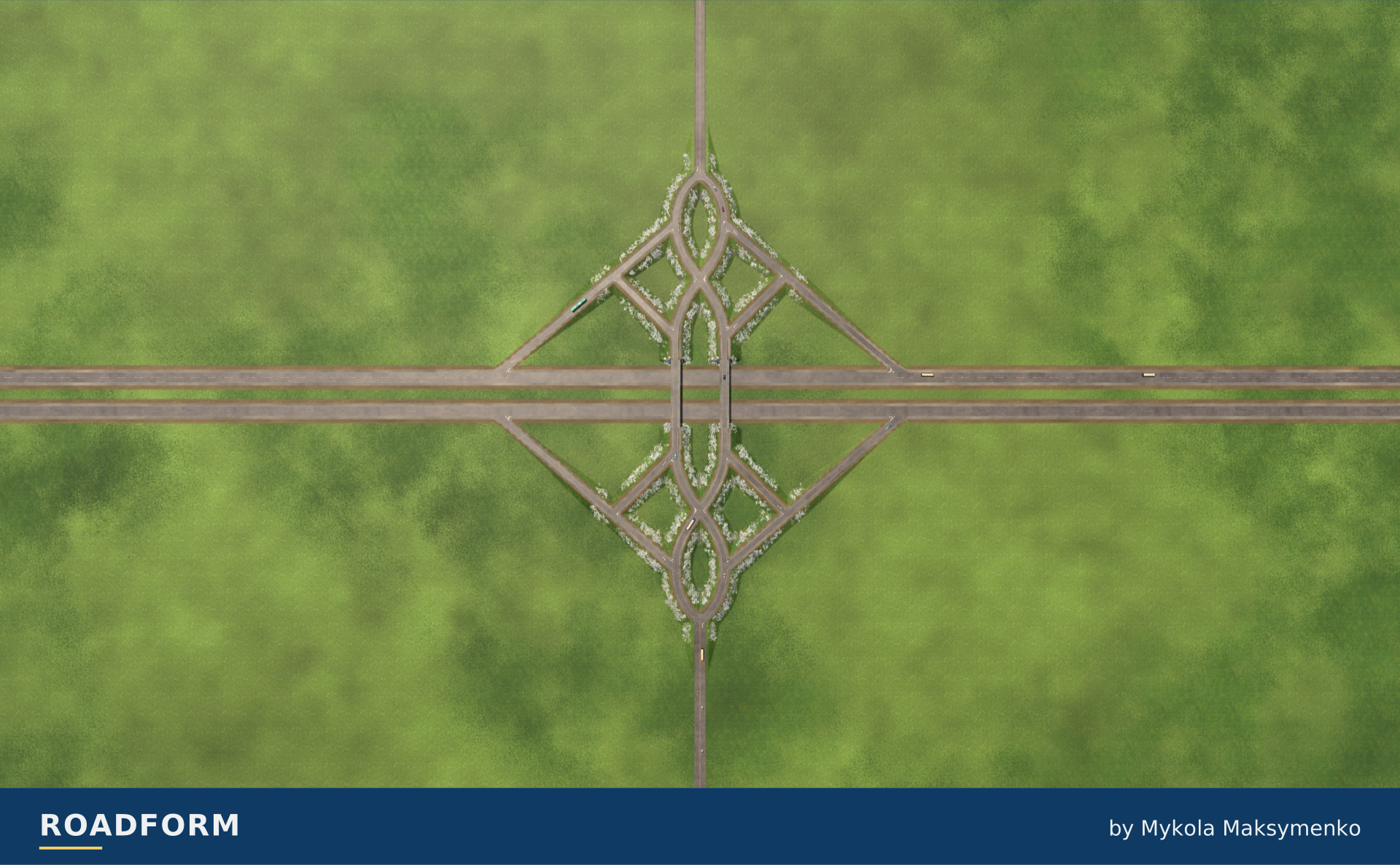
The road crosses to the left between two crossovers, so no left turn waits for oncoming traffic.
Reading the connections
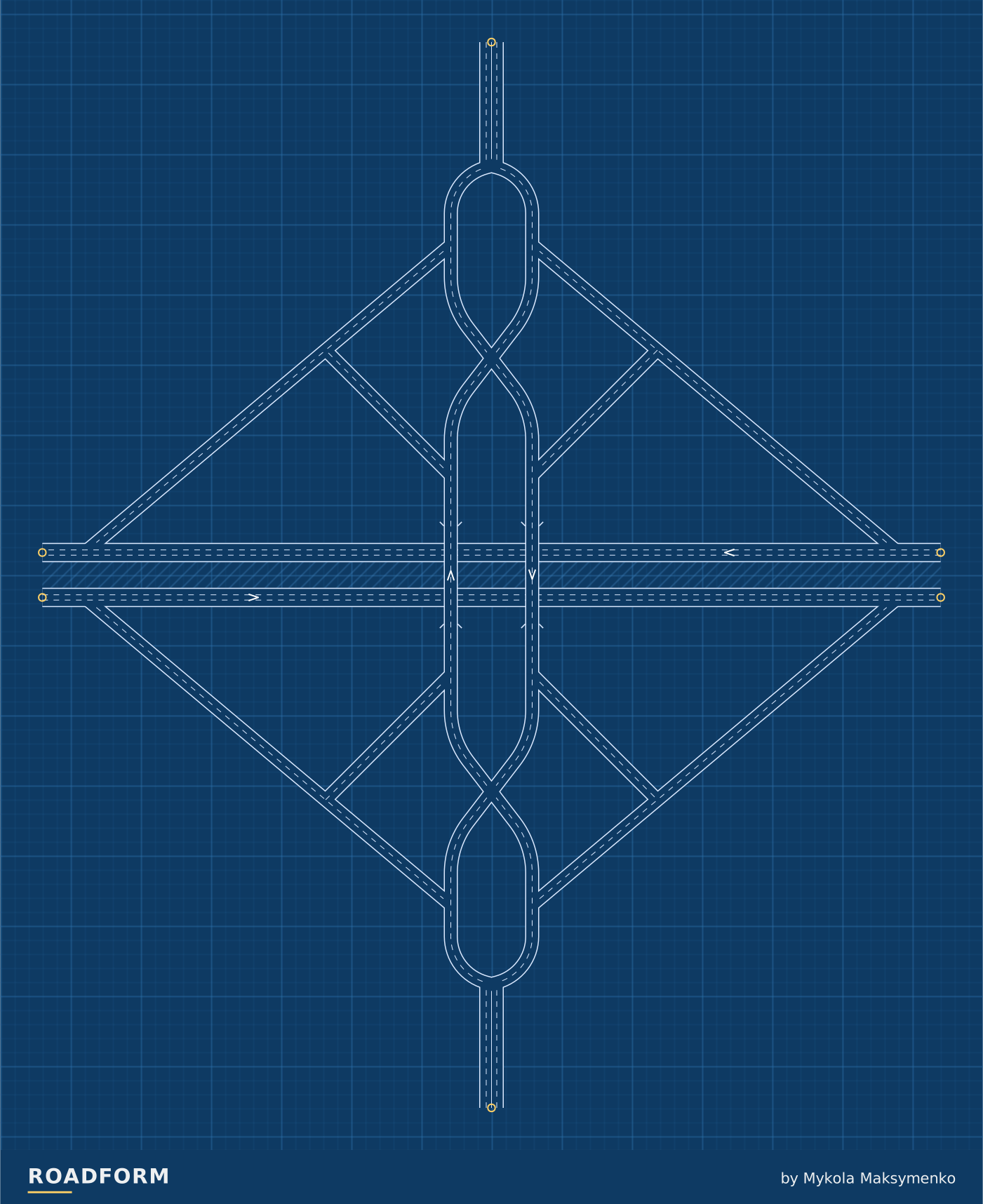
TF3 · M · On top: Road · Traffic side: Right.
Scale and capacity
Size changes the road widths and the space the layout needs. The guide below uses the default arrangement. The layout reserves room for wider roads.
| Layout | Width × depth | Highest road | Lanes per direction |
|---|---|---|---|
| S | 453 × 594 m | 8 m | Highway: 2 Cross road: 1 Ramps: 1 |
| M | 640 × 760 m | 8 m | Highway: 3 Cross road: 2 Ramps: 2 |
| L | 640 × 760 m | 8 m | Highway: 3 Cross road: 3 Ramps: 2 |
Which road takes the bridge?
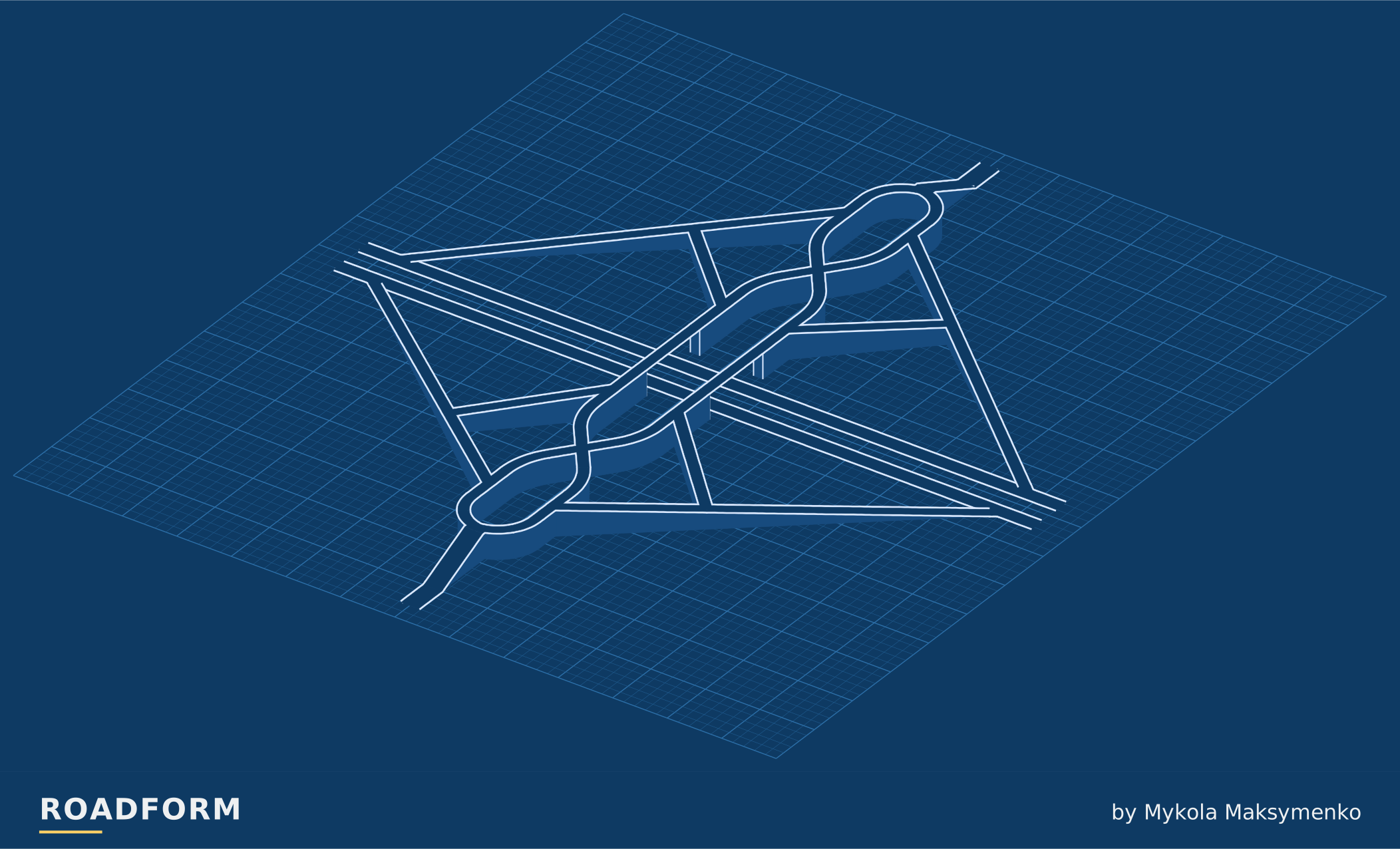
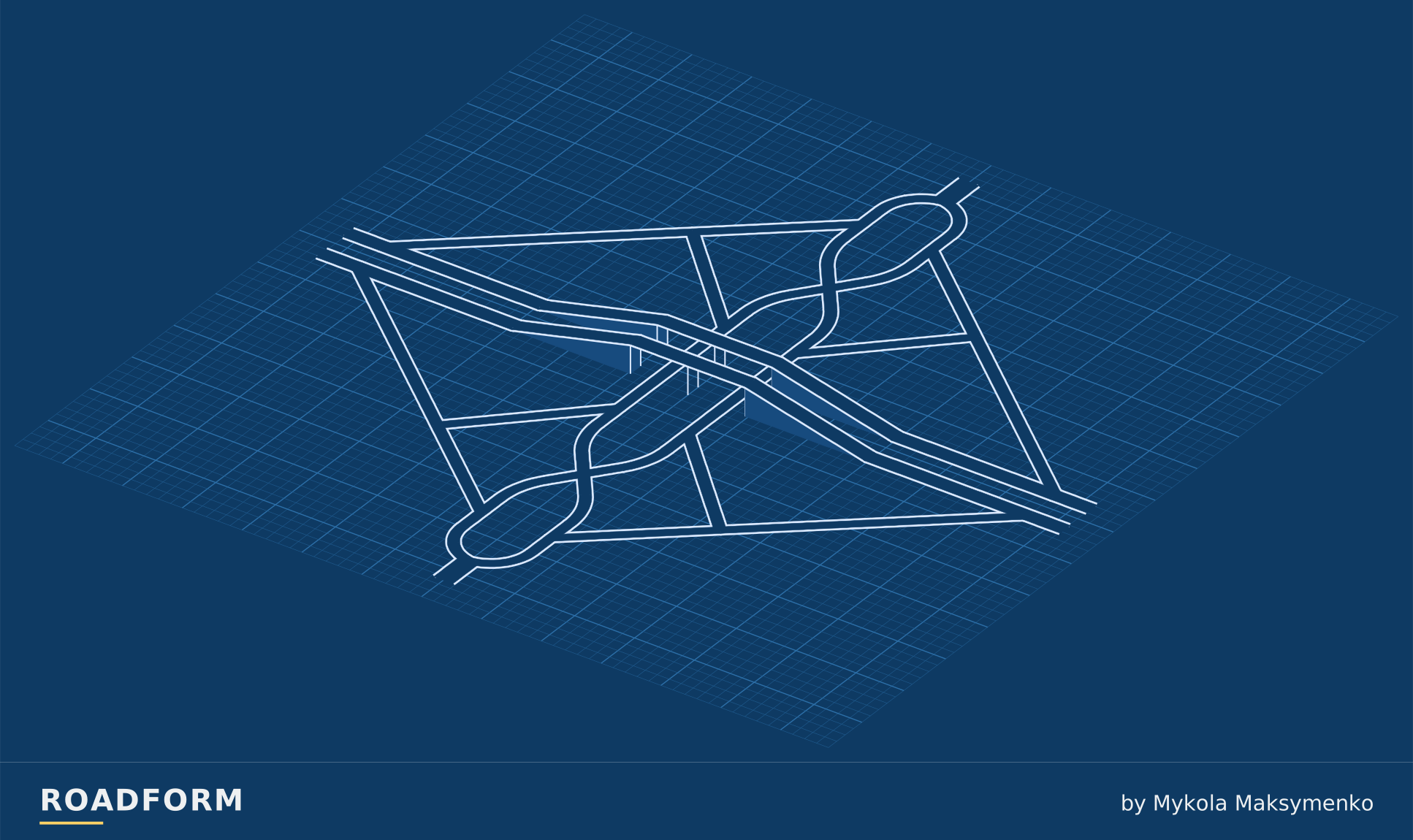
Choose which road runs above the crossing. This choice works with every form and size.
TF3 · M · Traffic side: Right. Heights ×3.

Sources and credits
- Diverging Diamond Interchange Informational Guide (FHWA-SA-14-067), Federal Highway Administration, 2014. rosap.ntl.bts.gov
- Alternative Intersections/Interchanges: Informational Report (FHWA-HRT-09-060), Chapter 7 Double Crossover Diamond Interchange, Federal Highway Administration, 2010. www.fhwa.dot.gov
- Evolution of Interchange Design in North America, J. P. Leisch and J. Morrall, Transportation Association of Canada, 2014. www.tac-atc.ca
- Engineering Policy Guide, 234.6 Diverging Diamond Interchanges, Missouri Department of Transportation. epg.modot.org
Real-world photo credits accompany each image. Roadform figures and measurements use Transport Fever 3.