On real roads
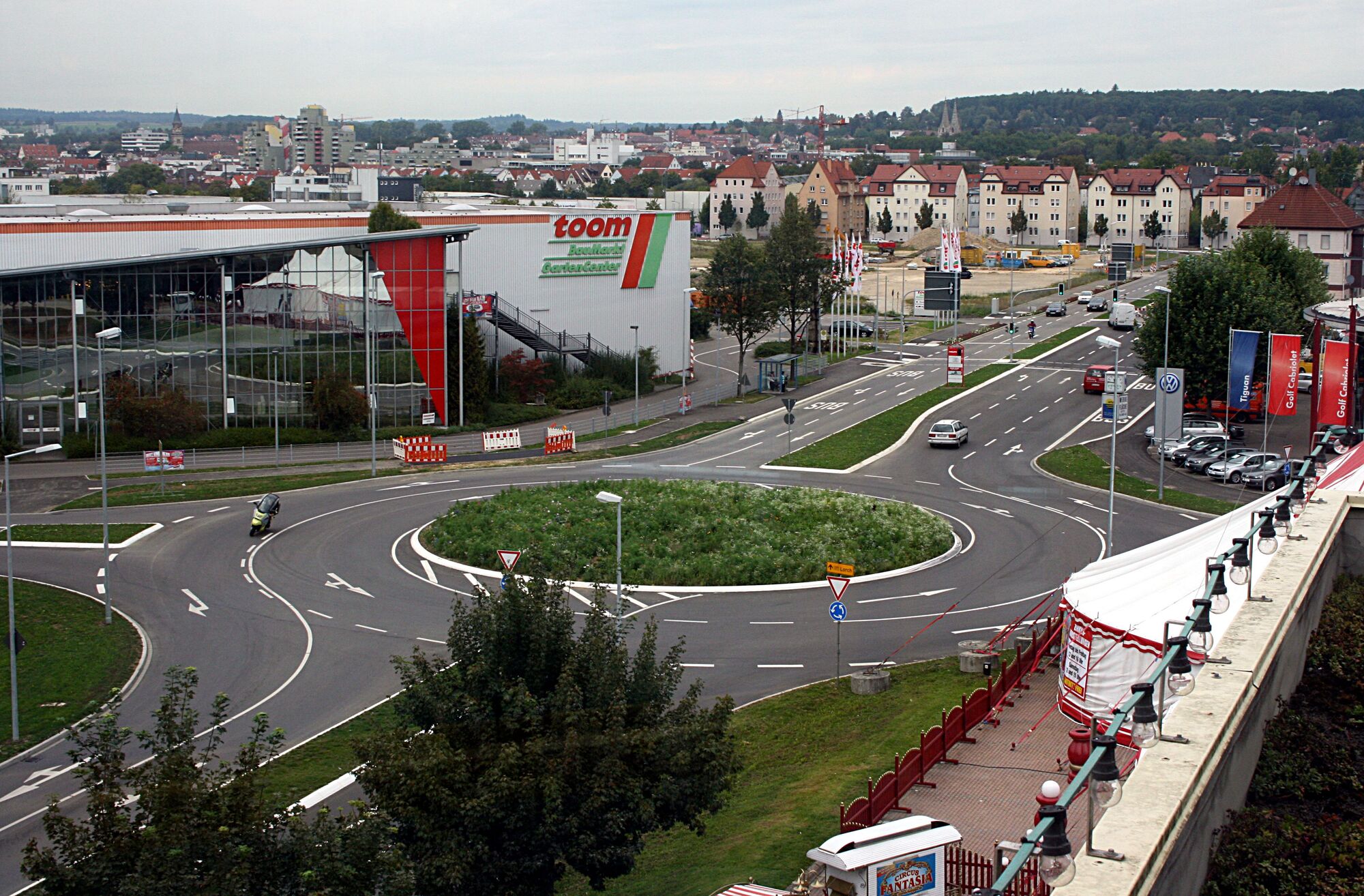
A turbo roundabout is a roundabout with more than one lane, whose lanes wind outward in a spiral and are kept apart by lane dividers, raised in the Dutch design.1 Drivers choose their lane before they enter and leave by it, so no one weaves or cuts in on the ring.1 Entering drivers give way to two lanes at most, and raised dividers keep speeds low.1 It has 10 conflict points, where a two-lane roundabout with two-lane exits has 20, and it can carry one and a half to two and a half times the traffic of a single-lane roundabout.1 The name comes from its turbine-like shape, not from the speed of its traffic.2
Lambertus (Bertus) Fortuijn, head of the traffic bureau of the province of South Holland, hit on the idea of the turbo roundabout on 3 October 1996.3 Ordinary two-lane roundabouts had brought weaving back, and in the Netherlands those with two-lane entries and exits had a relatively high number of crashes, most with damage only.1,3 A Delft student's thesis had found no truly safe roundabout besides the single-lane one, and Fortuijn set out to draw a two-lane roundabout without weaving.3 The first was finished in May 1999 as part of the bone-shaped Coldenhove roundabout, where the N220 meets the A20 at Maasland. The first in pure form was built in 2000 by the municipality of Barendrecht and the IJsselmonde water board, north of the A15.3
No entry may give way to more than two lanes, so each form fits its own pattern of traffic.3 The first that Fortuijn drew was the egg: two lanes on the main road's approaches and one on the side road's, which is safer for cyclists where the side road is quiet.3,4 Where more traffic comes from the side road, it gets two lanes as well; this form was the one first named turbo roundabout, and it is now the basic one.3 The spiral has three lanes on the ring and three-lane entries on two approaches; the rotor has three-lane entries on every approach.4 In the knee the inside lane starts at one approach only; the stretched knee and the star are made for three-leg junctions.1,4
The Dutch organisation CROW wrote the first design guidelines in 2008, and many countries started from them; Germany, Poland, the Czech Republic, Slovenia, Serbia and Croatia have written their own.2 By 2007 more than 70 were in use, almost all in the Netherlands, which no longer builds ordinary multi-lane roundabouts; by 2024 it had about 396, more than any other country.1,2 Germany introduced the turbo in 2002; it mostly paints the dividers, and recommends turbos only for junctions outside built-up areas or in areas becoming built up, for the safety of cyclists and pedestrians.2 Poland began in 2006 and had nearly 200 by 2024; there the turbo is now the standard choice for a two-lane roundabout.2 The first in North America was built at Victoria International Airport in Canada.4,5 The first in the United States was built in Jacksonville, Florida, and by late 2023 the country had four in operation, besides one ordinary roundabout converted to a turbo in 2022.2,6
- Levels
- 1
- Vehicle conflict points
- 10, against 20 on a two-lane roundabout with two-lane exits1
- Inner radius
- 12 m in the Dutch standard (10.5 to 20 m)1
- Size
- about 45 to 50 m across, with the 12 m inner radius1
- Lane dividers
- raised and mountable, 0.30 m wide, in the Dutch design1
- Capacity
- about 3,500 to 4,500 passenger car units an hour, at about 50 m across1
- Injury crashes
- 76 % fewer where 7 junctions were rebuilt as turbos (82 % before corrections)3
- Without raised dividers
- 59 % more crashes at the same traffic (9 Polish turbos)4
- Suits
- junctions where one lane is not enough: the Dutch, Polish and Czech guides call for it instead of the ordinary multi-lane roundabout2
- Limit
- a wrong lane cannot be put right by going round again1
Where to see one
The Roadform adaptation
In Roadform
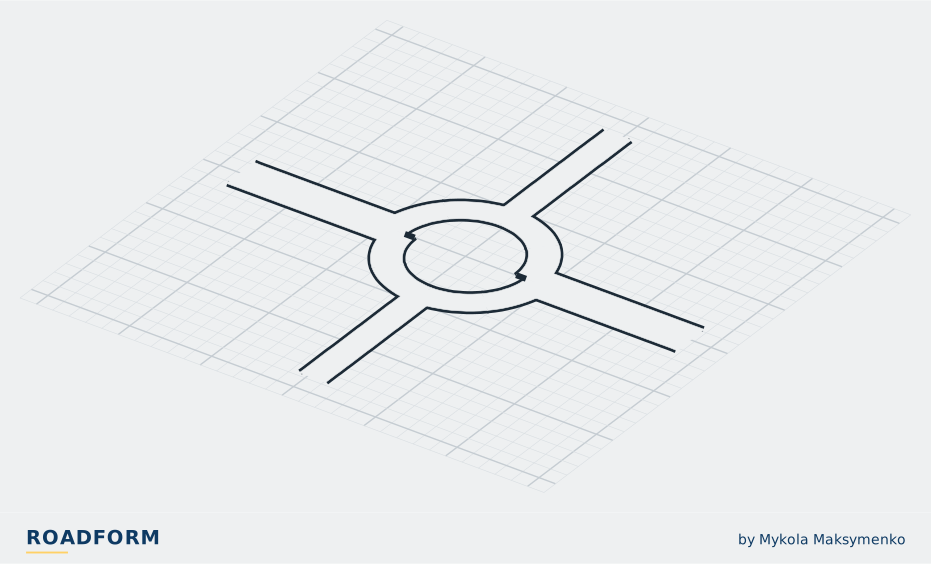
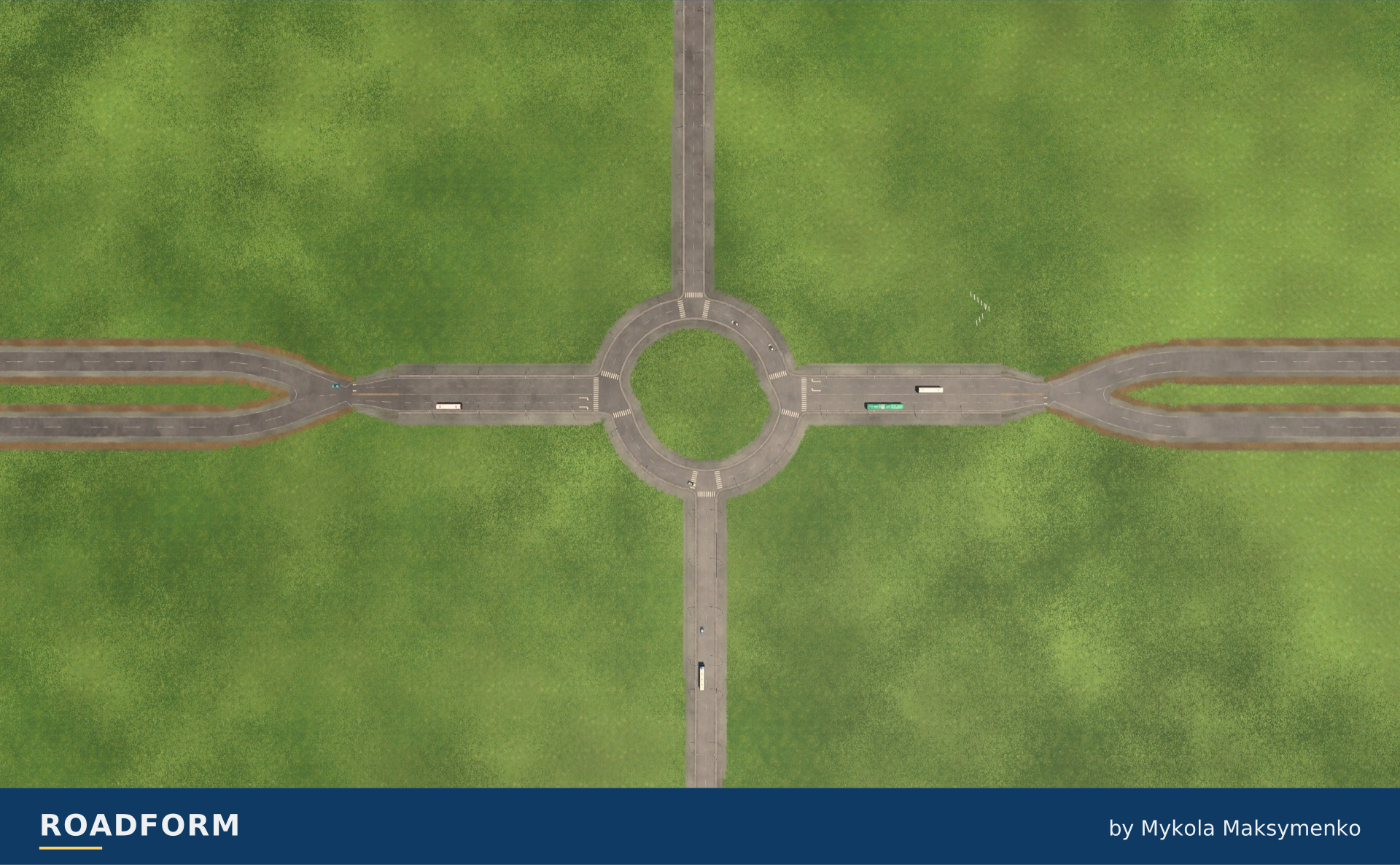
A two-lane spiral egg with preset, editable lane connections: choose your lane before entering.
Connections around the junction
Choose the number of connecting arms. The plans hold the other options at their defaults.
TF3 · Traffic side: Right.
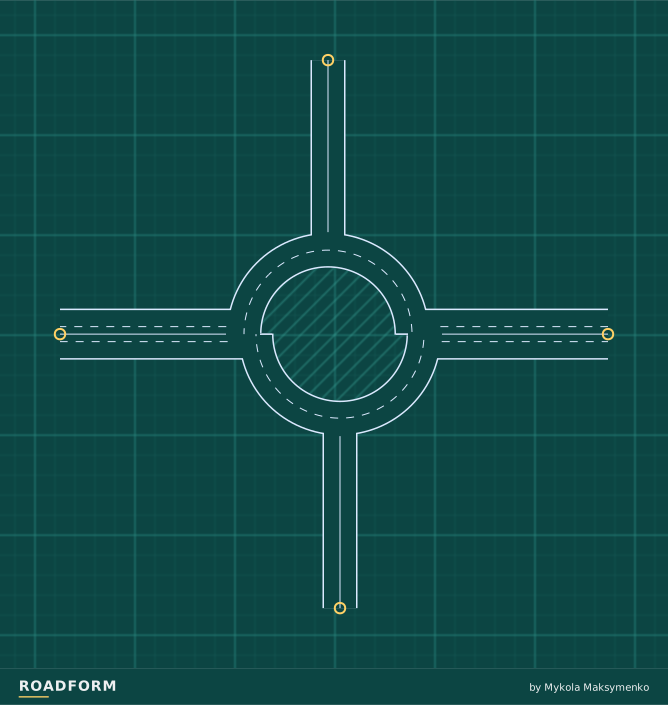
One fixed layout
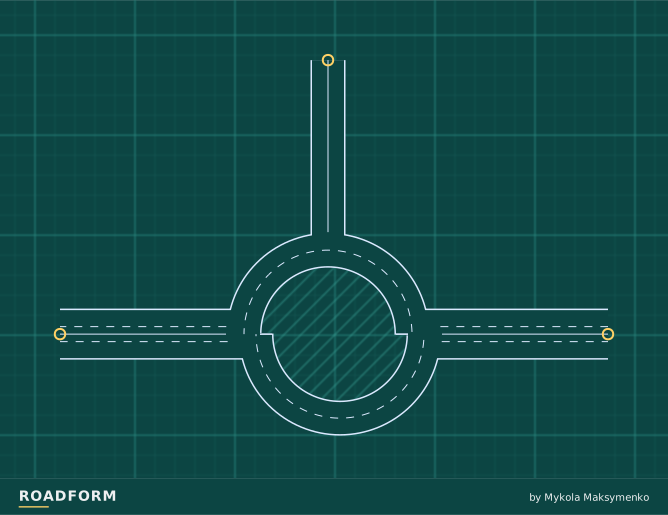
This design has no size selector. The measurements describe its default layout. The layout reserves room for wider roads.
| Layout | Width × depth | Highest road | Lanes per direction |
|---|---|---|---|
| Default | 274 × 274 m | 0 m | Ring: 2 Main arms: 2 Minor arms: 1 |
Sources and credits
- Roundabouts - Application and design: A practical manual, D. P. Overkamp and W. van der Wijk (Royal Haskoning, DHV) for the Dutch Ministry of Transport, Public Works and Water Management, Partners for Roads, 2009. open.rijkswaterstaat.nl
- Turbo Roundabouts: A Review of Practices in the Czech Republic, the Netherlands, and Poland (FHWA-HPL-24-015), Federal Highway Administration, Global Benchmarking Program, 2024. rosap.ntl.bts.gov
- Turborotonde en turboplein: ontwerp, capaciteit en veiligheid (doctoral thesis, with an English summary), L. G. H. Fortuijn, Delft University of Technology, 2013. repository.tudelft.nl
- Advancing Turbo Roundabouts in the United States: Synthesis Report (FHWA-SA-19-027), Federal Highway Administration, 2019. rosap.ntl.bts.gov
- The Turbo Roundabout, a First in North America, T. Murphy (Parsons), 2015 Conference of the Transportation Association of Canada, 2015. www.tac-atc.ca
- Turbo Roundabouts: Support Safety, Efficiency, and Increased Capacity, Federal Highway Administration, Office of International Programs, 2022. rosap.ntl.bts.gov
Real-world photo credits accompany each image. Roadform figures and measurements use Transport Fever 3.